Emergency 1975 Part :-1
Forty three years ago, on June 25, 1975, then Prime Minister Indira Gandhi clamped a national emergency that's been termed the darkest day of Indian democracy.This was the third national emergency (first one was in 1962 when China invaded India while the second one was in 1971 during the war with Pakistan), and the only one to be declared citing of "internal disturbances".During the 1975 emergency opposition leaders were arrested, elections postponed, anti-government protests crushed and press censored. Some laws were rewritten to suit the government.

A sudden power cut fell upon Delhi’s Bahadur Shah Zafar Marg which was home to most of the country’s largest newspapers. In other parts of the country, on the other hand, newspaper presses were raided and stopped and bundles of newspapers seized. In the early hours of the following morning, the then Prime Minister Indira Gandhi notified to the nation that the President has proclaimed Emergency on account of “imminent security threats” to the country. Soon after, constitutional rights of citizens were suspended and curbs placed on the freedom of the press. For the next couple of days, all major newspapers of the country could not be published. Gandhi expelled several foreign correspondents and over 200 journalists were arrested. The publications could be back two days later.
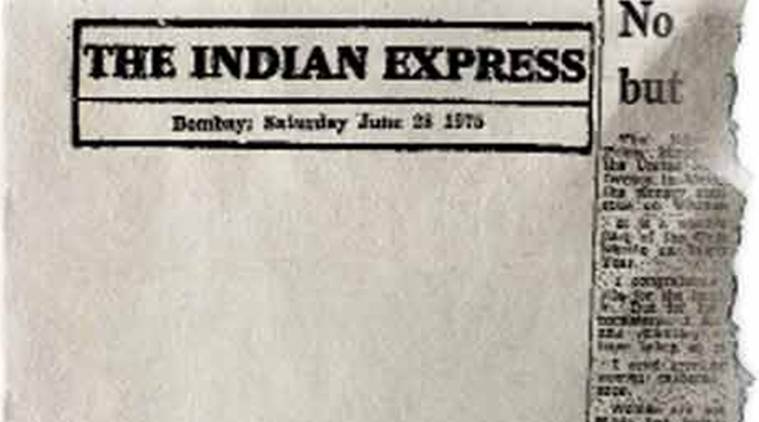
On June 28, when The Indian Express resumed its publication, it issued a front-page apology for being out of circulation for two days. It went on to report on the mass arrests that had taken place over the past two days. However, it was its framed blank editorial, representing censorship by the Indira Gandhi government in the name of Emergency, which gained maximum attention and would go on to be remembered for years down the line.
 But what was the reason of this blot on the face of Independent India? Could India have avoided it? Who benefitted and who suffered?
The Reason: Raj Narain, who had been defeated in the 1971 parliamentary election by Indira Gandhi, lodged cases of election fraud and use of state machinery for election purposes against her in the Allahabad High Court. Shanti Bhushan fought the case for Narain. Indira Gandhi was also cross-examined in the High Court which was the first such instance for an Indian Prime Minister.
On 12 June 1975, Justice Jagmohanlal Sinha of the Allahabad High Court found the prime minister guilty on the charge of misuse of government machinery for her election campaign. The court declared her election null and void and unseated her from her seat in the Lok Sabha. The court also banned her from contesting any election for an additional six years. Serious charges such as bribing voters and election malpractices were dropped and she was held responsible for misusing government machinery, and found guilty on charges such as using the state police to build a dais, availing herself of the services of a government officer, Yashpal Kapoor, during the elections before he had resigned from his position, and use of electricity from the state electricity department.
The verdict of the same was later challenged in Supreme Court which granted Gandhi a conditional stay. It allowed her to be an MP but not preside over parliamentary proceedings. This was viewed as the first step to emergency.
The second step was the 'Total Revolution' initiated by Jayaprakash Narayan who demended the resignation og Indira after the Allahbad High Court gave it's verdict. it was on the same day, June 25, that JP declared the nationwide plan of daily demonstrations in every state capital. The police, army and the people were asked to follow the Constitution than Indira Gandhi. The emergency is regarded as the outcome of a systematic failure as India was facing social, economic and political crisis.
After all the reasons were put out, it was assumed that Mrs. Gandhi was blinded by power and imposed the emergency to safeguard her own political and personal interests.
*Law: During the Emergency, Gandhi took to the liberty of rewriting the laws since her party had two thirds majority in the Lok sabha. Indira Gandhi felt that the existing laws were too slow and hence got the president to pass an ordinance which allowed Gandhi to rule by decree. Gandhi amended the Constitution such that it exonerated her from any charges in the election-fraud case. She also made sure that there was president's rule in the states where the government was anti- Gandhi. The 42nd amendment is considered to be one of the lasting legacies of the emergency.
1977 के आम चुनाव के बाद सूचना और प्रसारण मंत्री बने आडवाणी ने पत्रकारों को जो कुछ कहा वो यादगार बन गया. आडवाणी ने कहा, “आपको झुकने के लिए कहा गया था, आप तो रेंगने लग गए”
 *Impact of Emergency: Once the emergency was lifted, Congress faced the consequences of the same combined with the wrath of the general public. Writers wrote books and films were made about Emergency. Salman Rushdie's 'Midnight Children', VS Naipaul's ' India: A wounded Country' are some of the many books. Films like 'Kissa Kursi Ka' was a bold mockery of the dark phase. 'Nasbandi' and 'Aandhi' were some other films that played out the condition of the nation.

It was not just this, but after the Emergency was lifted, Indira Gandhi faced fierce critisizm for her actions. The result of which showed in the 1977 Lok Sabha Elections where Janata Party under the leadership of Morarji Desai came to power. Later, Indira was arrested on account of various cases against her.
On June 28, when The Indian Express resumed its publication, it issued a front-page apology for being out of circulation for two days. It went on to report on the mass arrests that had taken place over the past two days. However, it was its framed blank editorial, representing censorship by the Indira Gandhi government in the name of Emergency, which gained maximum attention and would go on to be remembered for years down the line.
But what was the reason of this blot on the face of Independent India? Could India have avoided it? Who benefitted and who suffered?
The Reason: Raj Narain, who had been defeated in the 1971 parliamentary election by Indira Gandhi, lodged cases of election fraud and use of state machinery for election purposes against her in the Allahabad High Court. Shanti Bhushan fought the case for Narain. Indira Gandhi was also cross-examined in the High Court which was the first such instance for an Indian Prime Minister.
On 12 June 1975, Justice Jagmohanlal Sinha of the Allahabad High Court found the prime minister guilty on the charge of misuse of government machinery for her election campaign. The court declared her election null and void and unseated her from her seat in the Lok Sabha. The court also banned her from contesting any election for an additional six years. Serious charges such as bribing voters and election malpractices were dropped and she was held responsible for misusing government machinery, and found guilty on charges such as using the state police to build a dais, availing herself of the services of a government officer, Yashpal Kapoor, during the elections before he had resigned from his position, and use of electricity from the state electricity department.
The verdict of the same was later challenged in Supreme Court which granted Gandhi a conditional stay. It allowed her to be an MP but not preside over parliamentary proceedings. This was viewed as the first step to emergency.
The second step was the 'Total Revolution' initiated by Jayaprakash Narayan who demended the resignation og Indira after the Allahbad High Court gave it's verdict. it was on the same day, June 25, that JP declared the nationwide plan of daily demonstrations in every state capital. The police, army and the people were asked to follow the Constitution than Indira Gandhi. The emergency is regarded as the outcome of a systematic failure as India was facing social, economic and political crisis.
After all the reasons were put out, it was assumed that Mrs. Gandhi was blinded by power and imposed the emergency to safeguard her own political and personal interests.
*Law: During the Emergency, Gandhi took to the liberty of rewriting the laws since her party had two thirds majority in the Lok sabha. Indira Gandhi felt that the existing laws were too slow and hence got the president to pass an ordinance which allowed Gandhi to rule by decree. Gandhi amended the Constitution such that it exonerated her from any charges in the election-fraud case. She also made sure that there was president's rule in the states where the government was anti- Gandhi. The 42nd amendment is considered to be one of the lasting legacies of the emergency.
1977 के आम चुनाव के बाद सूचना और प्रसारण मंत्री बने आडवाणी ने पत्रकारों को जो कुछ कहा वो यादगार बन गया. आडवाणी ने कहा, “आपको झुकने के लिए कहा गया था, आप तो रेंगने लग गए”
*Impact of Emergency: Once the emergency was lifted, Congress faced the consequences of the same combined with the wrath of the general public. Writers wrote books and films were made about Emergency. Salman Rushdie's 'Midnight Children', VS Naipaul's ' India: A wounded Country' are some of the many books. Films like 'Kissa Kursi Ka' was a bold mockery of the dark phase. 'Nasbandi' and 'Aandhi' were some other films that played out the condition of the nation.
It was not just this, but after the Emergency was lifted, Indira Gandhi faced fierce critisizm for her actions. The result of which showed in the 1977 Lok Sabha Elections where Janata Party under the leadership of Morarji Desai came to power. Later, Indira was arrested on account of various cases against her.


Comments
Post a Comment